

wolf trouble
a predator’s guide to surviving in the wilderness without accidentally committing mass murder or being hunted into extinction

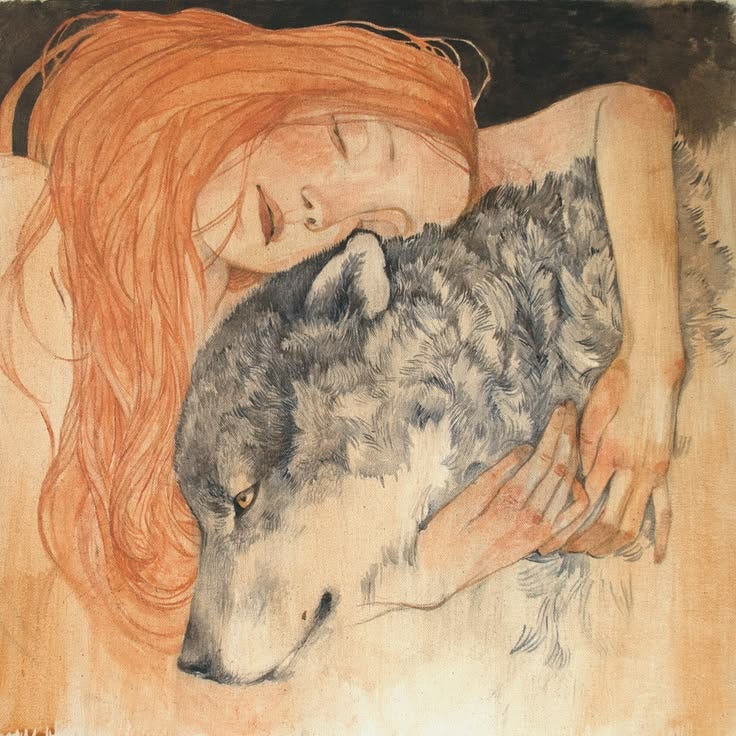
In his 1978 classic, Of Wolves and Men, the American natural history writer Barry Lopez devotes the better part of a chapter to the curious phenomenon of ‘surplus killing.’
Also known as ‘henhouse syndrome,’ surplus killing is a well-documented predator behaviour in which the wolf, confronted with an unexpected bumper crop of easy prey (a coop of nesting chickens, say, or a herd of dozy sheep or even a raft of suspicious interlopers who call themselves asylum seekers but frankly just smell weird) find himself overstimulated and temporarily goes haywire recklessly engaging in killing spree instead of doing what the wolf usually does, which is conserve its energy by dispatching only the prey it can eat in one sitting.
Surplus killing is frightening, spectacular, decadent and spectacularly pointless. In recent centuries, humans have excelled at it (for more information google ‘20th Century,’ ‘genocide’ and ‘mechanised warfare’). Hardly surprising since we’ve been thinking up new ways to kill other animals and eachother since before recorded history began. Things really got cooking around 9000 BC when we began shepherding ungulates and figuring out ways to neutralise the competition.
Animal husbandry + surplus killing = wolves-as-clusterfuck.
Even in their hey day, wolves posed almost no physical threat to humans compared to other wild predators. We hunted the wolf obsessively and ruthlessly, banishing it into near extinction because the spectre of surplus killing terrified us. Like us, wolves are pack hunters, tribal, ruthless killers yes but they are also intelligent, natural team players who share resources with the weak and older members of their pack. They are canny and aloof to the point of invisible. Unlike racoons, bears and foxes, they are not prone to scavenging.
The reason wolves terrified us was more complicated and disturbing than fear of predation. They seemed indifferent toward our complicated systems of organised surplus killing. The wolf was stand-offish, canny, unwilling to recognise our natural superiority. Perhaps it knew something we didn’t?
This air of mystery could be why wolves are so often cast as villains in fairy tales and fables, whereas more common burglars like foxes, racoons and bears barely get a look in. We fear the wolf because it reminds us of ourselves but isn’t us. So we demonised it in cave drawings, verses and song. When the wolf howled, it wasn’t a natural mammalian call and response, but an eery, occult communion with the moon. Instead of recognising surplus killing for what it was — a temporary madness brought on by specific, artificial man-made conditions — we blamed the wolf for revealing our own cruelty and decadence.
Our revulsion and fear of the wolf morphed into a cautionary tale that became received wisdom. The upshot was a centuries-long mass extermination that culminated in near total extinction everywhere except the most remote wilderness.
The point I’m trying to make here is not actually about wolves. It’s about human behaviour and the confusion that ensues when we are confronted with problems in multiple. Like wolves, most of us can make short work of chicken if we are hungry enough. Presented with chickens plural? That’s when things get interesting — and dangerous.
When problems multiply into clusterfucks, it’s easy to lose our way and resort to surplus killing like our wolf cousins. What we must endeavour to do in such an instances is to slow down and use our big brains to break the cluster down into smaller, more manageable, solvable fucks. But when our brains are flooded with cortisol and adrenaline wires get crossed. Everything speeds up, instincts scramble and thinking goes haywire. Disorientated and frenzied, we conflate the unrelated. Triage fails and practiced survival mechanisms backfire.
We hit upon a terrible plan: “I’ll vanquish the lot of you!’

A bit later, we wake up blood spattered, exhausted, give our wounds a lick and limp home, unsure of what’s happened. Unsure of anything really, except that we are simultaneously weak with hunger and oddly devoid of appetite.
If you’ve ever been caught in a clusterfuck and lashed out in fear anxiety you’ll recognise this morning-after-walk-of-shame-feeling I’m talking about. It’s awful. And if you don’t? Congratulations Smuggles, go back to your needlepoint.
In recent years I’ve become a reluctant expert at navigating clusterfucks. I’m much better than I was at resisting the natural temptation to give into the surplus kill frenzy. As life skills go, the ability avoid totally FREAKING in the eye of a pain-hurricane is handy indeed. A clusterfuck can make you or break you and I came close to the latter more than I’d like to admit. Beset by big problems in multiple it’s easy to find ourselves wondering, ‘Surely all these horrible, awful, no good, very bad things are happening to me at the same time for a reason?’
Good question, in theory. We must strive to be more accountable and alert to our many flaws and failings. But if, like me, in times of crisis you find yourself silently posing this question to yourself over and over again like a mantra while prostrating across the blistering hot sand of an imaginary desert? Just stop it. Unless you are the Zodiac killer in hiding, punishing yourself will help no one including yourself.
Good people get stuck with bad rubbish just as often as reprehensible humans get lucky. Subjectivity precludes objectivity so forget trying to assign blame in an effort to make sense of this nonsensical narrative. The only thing to be done in the face of a multiple-problem clusterfuck is to breath slowly and weather the storm without compounding the damage.
For most of my life I had a relatively easy ride. Of course I had problems, but they arose one by one, which allowed me to deal with them pretty efficiently and effectively. Plus admittedly many were self-inflicted, born of foolishness. Then one day, halfway through my forties, I found myself with two problems at once.
And these two problems? They were BIG PROBLEMS. Unforeseen, world-collapsing, immediately consequential and pressing. I’d never grappled with like of them before. I didn’t know anyone — not a single soul — who’d been through anything like what I was going through back then. Not only were these two big problems attacking me in tandem, they mated like gremlins and gave birth to a nightmarish nursery of baby problems who mated with each other incestuously in turn.
What did I do? I went to bed and failed to sleep. Then I got up and cared for my children brusquely and irritably, going through the motions but failing to give them the gift of my full attention. Then I sat down at my desk and failed to work and cooked healthy meals I failed to eat, saw my friends and failed to laugh, then I went to bed and failed to sleep all over again. For months I repeated this pattern and when that was done, I paced and panicked and wept and found some more important and interesting things to fail at. Most of which involved relationships with the opposite sex.
For a long time I went round and round like this, trying and failing in circles, needlessly killing every stupid chicken in the hen house without curiosity or appetite. On the surface I looked impressively functional, but my internal reality was roiling chaos dressed up as productivity. The best thing I failed at during this extended killing spree was conserving my energy. In the end nature won out and l collapsed in exhaustion. And that is how most people survive their first clusterfuck. I don’t recommend it.
In the hope you might be spared this unpleasant experience, below the paywall I’ve assembled a short compilation of tips for keeping your head above the waterline in a clusterfuck sink pit. It’s wisdom hard won after all other reasonable routes were exhausted. I promise if you follow it to the letter you will save yourself the horror of accidentally losing your mind and going on a mass murder spree (yes I’m being metaphorical). So if you or someone you care about is in the middle of a complicated crisis, or dealing with any problem however large, small, medium, singular or in multiples, please do read on. If nothing else it might just prevent you from getting shot by the farmer next door.
